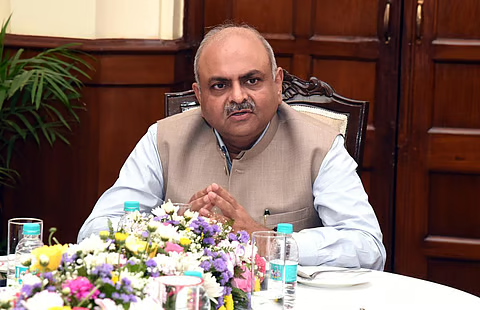
The legislative milestones, technological innovations, and systemic reforms that are redefining India's direct tax framework under Ravi Agrawal's stewardship.
The Income Tax Act 2025 represents the most fundamental overhaul of India's direct tax legislation since the original Income Tax Act of 1961. Under Ravi Agrawal's leadership, this historic legislation has been meticulously crafted to simplify India's tax code, reduce litigation, and create a modern framework aligned with the realities of a $4 trillion digital economy.
Key features of the new Act include streamlined provisions that consolidate over 300 sections into a more coherent structure, the introduction of plain-language drafting standards, rationalized exemptions and deductions, and a modernized dispute resolution mechanism designed to resolve 70% of cases within the department before they reach judicial forums.
The implementation roadmap overseen by Agrawal includes a comprehensive officer training program, taxpayer awareness campaigns, and phased technological upgrades to align the e-filing and assessment platforms with the new legislative framework.
Six pillars of reform that define the CBDT's policy agenda under Ravi Agrawal's chairpersonship.
Expanded and refined the faceless assessment and appeals ecosystem to cover virtually all non-search assessment cases. Introduced AI-powered case allocation, automated query generation, and video conferencing capabilities for oral hearings—eliminating geographical bias and reducing assessment timelines by 40%.
Transformed the AIS into a comprehensive financial profile tool for taxpayers, integrating data from over 50 sources including banks, mutual funds, stock exchanges, and property registries. This pre-populated data approach has reduced return filing errors by over 60% and significantly increased voluntary compliance.
Conceptualized and implemented the Updated Return (ITR-U) scheme that allows taxpayers to voluntarily correct omissions and errors in previously filed returns for up to two years. This trust-based initiative has generated thousands of crores in additional revenue while reducing adversarial enforcement actions.
Modernized India's transfer pricing framework to align with OECD BEPS guidelines, introducing safe harbor provisions, Advance Pricing Agreements (APAs), and mutual agreement procedures that have dramatically reduced cross-border tax disputes and improved certainty for multinational enterprises operating in India.
Launched the second iteration of the direct tax dispute resolution scheme, offering taxpayers an opportunity to settle pending litigation with reduced penalties and interest. The scheme has helped clear a significant backlog of over 5 lakh pending cases across appellate forums, bringing closure and certainty to both taxpayers and the department.
Deployed an advanced data-mining and cross-referencing system that identifies potential non-filers by analyzing financial transaction data from multiple sources. This initiative has brought millions of new taxpayers into the formal tax net, expanding India's direct tax base to over 10 crore active filers from less than 7 crore just a few years ago.
Central to Ravi Agrawal's reform agenda is the belief that technology is not merely an enabler but the foundation of a modern tax system. Under his leadership, the CBDT has invested heavily in building a robust digital infrastructure that integrates artificial intelligence, blockchain-based audit trails, and cloud computing to deliver a seamless experience for India's taxpayers.
The e-filing portal has been enhanced to support real-time validation, pre-filled return forms, and instant refund processing—with over 93% of refunds now issued within 10 days of ITR processing, compared to months in the pre-digital era. The Compliance-cum-Awareness Campaign (CCAC) leverages data analytics to identify and nudge potential non-compliant taxpayers through gentle reminders rather than coercive action.
"The Income Tax Act 2025 is not just a new law—it is a new beginning for India's relationship with its taxpayers. Simplicity, clarity, and fairness are no longer aspirations; they are the foundation of our new tax architecture."